Financial inclusion is often measured by the number of people who have a bank account. From that perspective, progress has been substantial: 79% of adults globally had an account in 2024, up from 62% a decade earlier, according to the World Bank. Yet for many individuals, communities, and businesses, access alone does not guarantee meaningful participation in the economy.
Financial products and services can do little to improve financial well-being when they are difficult to use, unaffordable, poorly matched to people’s needs or disconnected from wider support systems. Put simply, access does not always translate into inclusion.
This distinction is at the heart of the Global Alliance for Banking on Values (GABV)’s vision on financial inclusion. To better understand the different layers of financial exclusion, the GABV surveyed its member institutions across 45 countries.
The findings underpin Faces of Inclusion, the theme of Banking on Values Day 2026, which explores who is being left behind, the barriers they face, and how values-based banks are responding.
Access is essential, but it is only the beginning
For 36% of GABV respondents, financial exclusion most often occurs because people cannot access financial services at all. But the findings also show that availability does not guarantee meaningful inclusion. Nearly two-thirds pointed to exclusion that persists even where services exist: because they are not adapted to people’s needs (42%), are not trusted or widely used (14%), or are too expensive (8%).
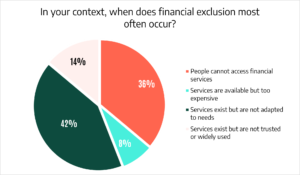
In open responses, institutions described services that were technically available but remained out of reach because of high costs, complexity, documentation requirements, low trust, limited financial capability or products that did not meet customers’ needs.
➤ Account ownership is an incomplete measure of financial inclusion.
Who remains excluded, and why
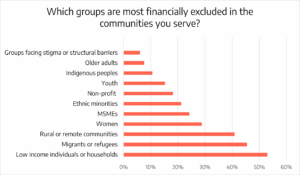
According to the survey, and across very different social and economic contexts, the most frequently financially excluded were low-income individuals or households (53%), followed by migrants and refugees (45%), rural or remote communities (41%), women (29%), and micro, small and medium-sized enterprises (MSMEs, 24%).
When asked about the main barriers to financial inclusion for those groups, respondents pointed primarily to features of the financial system. Lack of collateral or eligibility was cited most frequently (62%), followed by limited financial literacy or awareness (42%) and lack of documentation or legal identity (38%).
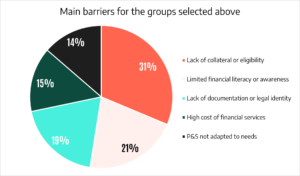
Respondents also mentioned digital exclusion (18%), lack of trust in financial institutions (15%), and regulatory or policy barriers (13%) as important barriers.
Together, these findings challenge explanations that place responsibility primarily on individuals. In many cases, exclusion reflects eligibility rules, documentation requirements, costs and product designs that do not fit people’s circumstances.
➤ Financial exclusion often reflects how financial systems are designed, not simply the circumstances or capabilities of the people they fail to serve.
What exclusion costs
Financial inclusion has widespread benefits. When people can save securely, access appropriate finance, build businesses and manage risks, they are better equipped to withstand economic shocks and participate in the economy. The positive, knock-on effects extend to families, communities and local economies.
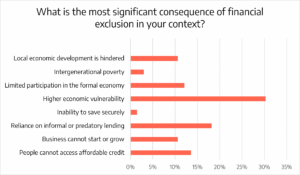
The survey found that the most significant consequence of financial exclusion was higher economic vulnerability, cited by almost a third of respondents. This was followed by increased reliance on informal or predatory lending (18%), the inability to access affordable credit (14%), and limited participation in the formal economy and employment (12%). Respondents also pointed to barriers to business creation and growth, and to constrained local economic development, both at 11%.
Open responses reinforced this picture. Institutions described dependence on informal lenders, difficulty obtaining affordable credit, constraints on starting or expanding businesses, and greater exposure to financial shocks. The IFC – the largest global development institution focused exclusively on the private sector in developing economies – estimates that the financing gap for micro, small and medium-sized enterprises is USD 5.7 trillion. The figure is striking given MSMEs account for more than 90% of firms worldwide and, on average, 70% of employment and 50% of GDP.
The economic implications extend well beyond individual households and businesses. An EY analysis estimated in 2017 that broader access to banking, savings and lending products could increase GDP by up to 14% in large developing economies such as India and by up to 30% in frontier markets such as Kenya, but could also increase banking revenues by USD 200 billion. These are scenario-based estimates rather than observed effects, but they illustrate the scale of economic activity that financial exclusion may be preventing.
➤ Financial inclusion contributes to long-term economic development and resilience.
What effective inclusion looks like
When respondents were asked which approaches are most effective in advancing financial inclusion, three solutions received the strongest support: relationship banking (52%), tailored financial products (50%) and financial literacy initiatives (41%). Digital solutions were selected by 20% of respondents.
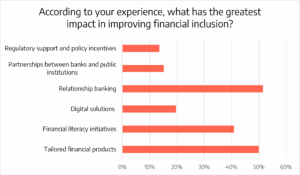
These findings suggest that successful inclusion depends more on understanding customers than on technology. While technology remains important to extend reach and reduce costs, alone it cannot overcome a lack of trust, unsuitable eligibility criteria, or products that do not reflect irregular incomes, rural livelihoods, or small-business cash flows. Respondents placed greater emphasis on customer understanding, local knowledge and human relationships, alongside financial guidance and education.
➤ Financial services are more likely to create opportunity when institutions know their customers, design around their circumstances, and combine finance with trust, education and long-term support.
Commitment is high, but measurement remains a challenge
Perhaps unsurprisingly, in a survey of leading values-based banks, 55% of respondents reported that financial inclusion-related activities represent more than a quarter of their portfolio. This includes 29% who said that such activities account for more than half of their portfolio.
However, the survey also revealed an important gap between commitment and measurement. Only 42% of respondents reported tracking financial inclusion outcomes systematically, while others said they track outcomes only partially, informally, or not at all.
Participating institutions therefore appear to be further advanced in delivering inclusion initiatives than in assessing their longer-term outcomes.
➤ More consistent outcome measurement could help banks understand what their efforts achieve, identify gaps and improve their approaches over time.
Regional patterns differ
Although regional samples are too small to support representative comparisons, responses point to differences in emphasis across markets.
- Among participating banks in North America, low-income households and ethnic minorities were identified most frequently as underserved. Trust in financial institutions was also more prominent in this group, pointing to the value of long-term community relationships and trust-building.
- Responses from Latin America and the Caribbean placed particular emphasis on the challenges facing MSMEs and women entrepreneurs, as well as on relationship banking and tailored financial products.
- Participating institutions in Africa frequently highlighted tailored products and reported strong institutional commitment to financial inclusion, including systematic impact tracking and substantial portfolio allocations.
- Within Europe, product suitability received particular attention. Respondents highlighted barriers affecting non-profit organisations, migrants and other underserved groups despite the broad availability of financial services.
- Asia-Pacific responses placed particular emphasis on collateral and eligibility requirements, alongside tailored products for low-income households, women, rural communities and small businesses.
➤ Across different contexts, participating values-based banks consistently emphasised local presence, an understanding of local needs, tailored lending, inclusive product design and trust-building.
Financial inclusion in practice
Responding institutions also shared concrete examples of how they advance financial inclusion. The following approaches reflect several of the layers identified by the survey and are featured as stories and best practices in the Faces of Inclusion campaign for Banking on Values Day 2026.
- Opportunity Bank Uganda provides financial literacy and business management training for refugees, women, youth and smallholder farmers.
- ACBA Bank, in Armenia, has more than half of its loan accounts in underserved rural regions, supported by relationship-based agricultural lending and financial literacy programmes.
- Banco Integral, in El Salvador, implements a relationship-based approach to help clients move from informal finance into the regulated financial system while strengthening business capabilities through education and advisory services.
- BRAC Bank, in Bangladesh, has succeeded in serving the country’s ”missing middle” by replacing traditional collateral requirements with cash-flow-based lending approaches, allowing entrepreneurs without conventional assets to access finance and maintain strong portfolios.
- Credit Human, in the United States, offers a lower-cost alternative to payday loans for members who cannot qualify for traditional credit products. The product is designed to meet short-term financial needs without the costs associated with higher-priced payday or title loans.
➤ There is no single route to financial inclusion: effective solutions respond to the realities of the people and communities they are designed to serve.
A structural problem requires an ecosystem
Values-based banks recognise that financial institutions cannot achieve financial inclusion alone. When asked for the single most important action governments or regulators should take, 41% chose aligning incentives or requirements for banks with financial-inclusion objectives. Supporting financial-literacy initiatives followed at 26%, while stronger consumer-protection frameworks and improved digital infrastructure each received 12%.
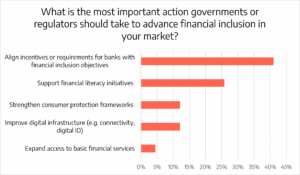
The Global Alliance for Banking on Values (GABV) believes these responses underline the need for action across the wider financial ecosystem. Governments, regulators, financial institutions, educational organisations, civil society and community actors all have a role to address the barriers that continue to exclude people and businesses from economic opportunity.
➤ Financial inclusion depends on an ecosystem.
From access to agency
The survey findings support the view that the challenge is not simply to expand access. It is to build financial systems that are accessible, affordable and applicable: within reach, fairly priced and designed around people’s needs and circumstances.
When financial services reflect the realities of individuals, businesses and communities, there is compelling evidence that they can strengthen people’s agency over their economic lives. These benefits extend beyond individuals, supporting opportunity, stronger communities and wider social and economic development.
GABV member banks’ experience indicates that relationships, trust, tailored solutions and financial capability are central to meaningful inclusion.
➤ True financial inclusion is not simply about bringing people into the financial system. It is about ensuring that the financial system works for them once they are there.
In its Position Paper on Financial Inclusion, the GABV argues that building a financial system that works for everyone requires coordinated action to:
- Guarantee access to fair and meaningful financial services for all
- Strengthen foundations such as consumer protection and financial literacy
- Support mission-driven and community-focused models that reach underserved groups
- Treat financial inclusion as a human right, not as a market choice.
Methodological Note
This article draws on responses from 66 financial institutions in the GABV across 45 countries to a survey between July and September 2026. Together, they represent 89% of the GABV’s membership. The survey reflects the perspectives and experiences of participating institutions in their own contexts and should not be interpreted as representative of entire countries or regions.
Several questions allowed multiple responses, so combined percentages may exceed 100%. Regional comparisons are based on relatively small samples in some regions and may also reflect differences in institution type. Observed associations should not be interpreted as evidence of causation.
This caveat is particularly important for regional patterns. The survey offers practitioner insights into financial exclusion and the approaches used by participating values-based banks; it does not provide statistically representative estimates at regional or global level.