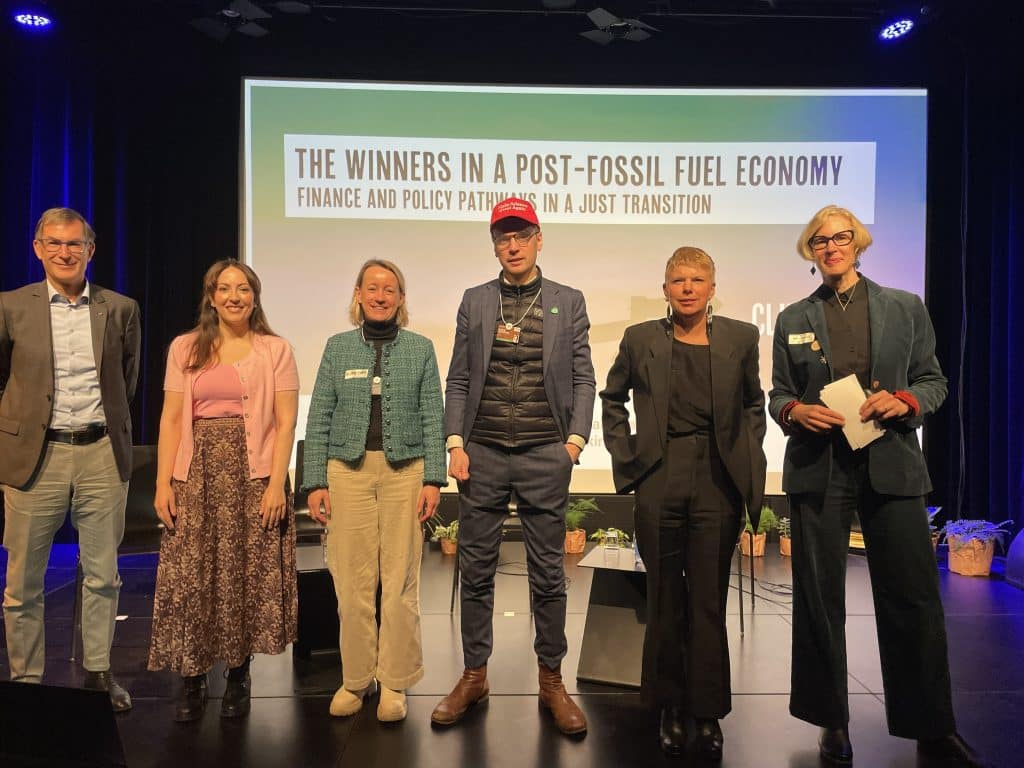
:In the heart of Davos, amid the shifting geopolitical landscape of 2026, a diverse panel of leaders convened to address one of the most pressing questions of our time: how can finance and policy accelerate a just transition to a post-fossil fuel economy? The session took place at Climate Hub Davos curated by GreenUp and brought together perspectives from global banking, civil society, climate policy innovation, and values-based finance.
The speakers, Anne-Sophie Castelnau (ING), Ingmar Rentzhog (We Don’t Have Time), Martin Rohner (Global Alliance for Banking on Values) and Amiera Sawas (Fossil Fuel Non-Proliferation Treaty Initiative), shared a conviction: despite unprecedented headwinds, those who embrace the transition will become tomorrow’s winners.
The Context: Light and Darkness
As moderator, Katarina Wangler Björk, Chief Impact Officer at Exponential Roadmap Initiative, set the context for the conversation.
Recent research by Carbon Majors shows only 32 companies are responsible for 50% of global fossil fuel emissions, down from 36 just a few years ago. Many of these companies are state-owned, revealing the deep geopolitical complexity that makes this challenge so difficult to address. At COP 30, more than 80 countries joined a call to phase out fossil fuels, but significant opposition remained, highlighting a fractured international consensus.
Yet many countries and companies are successfully decoupling emissions from economic growth, providing evidence that the narrative of inevitable economic sacrifice is false. They demonstrate that the transition is not only possible but can be economically advantageous. “The question is no longer whether the transition can happen, but how quickly it can be scaled and what role different actors will play in accelerating it,” said Wangler.
The Battle for Science and Information
Ingmar Rentzhog began by acknowledging what many in the room were feeling, but few were saying aloud: “We live in very troubled times, very much fueled by those who want to stay in power.” His assessment was stark. The fossil fuel industry has evolved from denying climate change to attempting to cancel science itself.
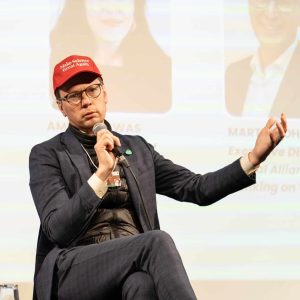
The evidence Rentzhog presented was disturbing. Scientists in the United States are leaving the country, taking climate data with them to Europe to preserve it. The Mauna Loa Observatory in Hawaii, which has measured atmospheric carbon dioxide every single day since the 1960s and is considered ground zero for climate monitoring, faces threats of shutdown. Satellites collecting climate data are being destroyed. In Germany, the AfD party wants to dismantle all wind power plants because they are “ugly.” In the United Kingdom, media coverage that was once predominantly supportive of climate action has shifted, with positive voices now in the minority.
“The information war is actually happening, and that’s really dangerous.”
Yet this backlash reveals a crucial truth: clean energy is winning. Investment has reached USD 5 trillion annually, and is projected to reach USD 7 trillion—7% of global capital flows. In the US, 96% of new electricity capacity is fossil-free. Norway saw 100% electric car sales in 2025.
“We’re feeling the resistance because we’re starting to break through,” Rentzhog explained. His solution includes the Make Science Great Again campaign and a European social media platform to counter misinformation. “We can say, ‘I believe in science, Mr. President,” he said in clear reference to Trump.
“In the climate movement, all of us need to feel like winners because we are on the right side of history. The other side will try everything they can to force people to give up. Don’t let them do that.” (Ingmar Rentzhog, We Don’t Have Time)
Building a Global Framework
Amiera Sawas, Strategic Head of Research and Policy at the Fossil Fuel Non Proliferation initiative, framed the moment: “We’re witnessing a global turning point in power dynamics.” The climate movement has struggled to engage people captured by opposing narratives. “We’re not doing a good enough job engaging people in the story of the future: why we need this transition and how they’re part of it.”
The Fossil Fuel Non-Proliferation Treaty addresses this through three pillars: end expansion of new fossil fuel projects (currently 120% more are planned than compatible with 1.5°C), phase out existing projects equitably, and enable a just transition for workers and communities. The initiative now has 18 country endorsements, and support from over 4,200 organisations, including 25 GABV member banks, the first financial network in the world to endorse.
”We don’t judge the role of fossil fuels in the past, but we recognise the need to step out now, and come with credible proposals that make sense.” (Amiera Sawas, Fossil Fuel Treaty initiative)
The economic barriers are stark. Africa has the greatest renewable potential but receives under 3% of global investment, facing interest rates of over 15% versus 2-6% in the Global North, noted Sawas. African public debt has doubled to over $1 trillion in five years. The initiative is developing debt resolution facilities and financing mechanisms to address these barriers.
Crucially, the International Court of Justice has ruled that states have an international legal responsibility to address fossil fuels and subsidies, empowering emerging court cases globally.
And there’s other evidence of positive progress. The first diplomatic conference on just transition from fossil fuels will be held in Santa Marta, Colombia, in April 2026, co-hosted by Colombia and the Netherlands, to address economics, energy access, and international cooperation.
Corporate Banking Leadership
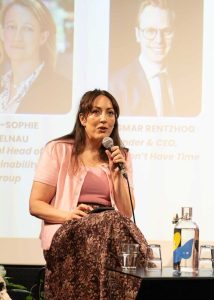
Anne-Sophie Castelnau, Global Head of Sustainability at ING, brought ING’s perspective as the first global systemic bank with Science-Based Targets Initiative approved climate targets. With a €1 trillion balance sheet, ING has tripled renewable energy commitments over three years to €7.5 billion in 2025.
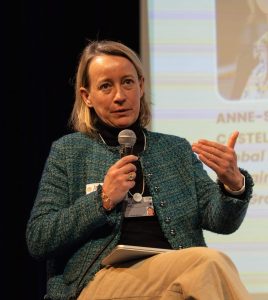
”Stepping away overnight doesn’t have real impact,” Castelnau explained. “What has impact is supporting the transformation of the economy. Unplugging from fossil fuel will take time and effort. Today we’re still 80% dependent.”
ING engages with clients in depth, analysing disclosures and transition plans, and monitoring progress year after year. The bank has co-designed sector transition financing frameworks including the Poseidon Principles for shipping and the Sustainable Aluminium Financing Framework.
The challenge? In heavy industries like steel and cement, low-carbon alternatives often have negative business cases. “Our clients say, ‘We share the same views, but I’m a listed company. I cannot get board approval for projects that are far less profitable,” said Castelnau.
The solution requires government intervention – regulation, incentives, and de-risking mechanisms.
“We need to bring our narrative to citizens and make it accessible. People want to take action. Climate change is here, it’s growing, and it brings risks. As a banker, I can see those risks.” (Anne-Sophie Castelnau, ING)
Yet amid political turbulence, one finding provides hope: ING’s large corporate clients are maintaining their transition course. They’ve made medium-to-long-term strategic decisions and appreciate continued support.
Castelnau emphasised putting people at the heart of this work. “We’re not doing this only to save the planet. We’re doing this for society.” But she acknowledged a gap: “Looking at how citizens vote, this isn’t clear enough. We need to make the transition story sexy and accessible so people feel they can make a difference.”
Values-Based Banking in Action
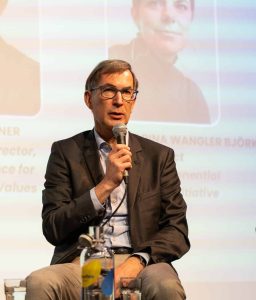
Martin Rohner, Executive Director at the Global Alliance for Banking on Values (GABV), offered a counterweight to the challenges. Leading the GABV, a global network of 70+ banks across 46 countries putting people and planet first Rohner hears daily from around the world. “When I see the media and the discourse coming from the United States in particular, there’s a huge disconnect from what I’m hearing. That gives me energy and hope that change is possible.”
Most GABV members operate with strict fossil fuel exclusion criteria. Their investors want impact over maximum returns, giving these banks room to innovate. As well as strengthening its members to help them deliver more impact, the GABV aims to influence the financial sector more broadly. It helped globalise the Partnership for Carbon Accounting Financials in 2019; today over 700 institutions, including ING, use the PCAF methodology to assess and disclose their greenhouse gas emissions.
The tangible benefits of being frontrunners? Credibility for policy engagement, client loyalty translating to financial advantages, better risk management by being grounded in the community served, and commercial opportunity. Founding GABV member, Triodos Bank in the Netherlands, for example, has become the world’s leading arranger of renewable energy deals.
“Values-based banks profit from doing the right thing. Being frontrunners in the climate finance space has brought tangible benefits to our members in numerous ways.” (Martin Rohner, GABV)
Rohner shared striking examples. BRAC Bank in Bangladesh remained apolitical during an oppressive regime, focusing on impact. After the revolution in 2024, when other banks collapsed, BRAC became Bangladesh’s largest bank as people rushed to bring their money to the country’s most responsible bank. While Climate First Bank in Florida has grown to $1.5 billion in four years, installing solar roofs on 80,000 homes in a challenging political environment.
“We see every day that values-based banks actually profit from doing the right thing. But the real acceleration comes when finance, business, and civil society work together. If policymakers create the right conditions, we can unlock change at a completely different level,” Rohner noted.
The Path Forward
The panel revealed critical convergence. Decarbonisation requires USD 4-5 trillion in additional capital. Technology is reaching maturation points creating market opportunities. First-movers are building competitive advantage. Countries and companies are proving emissions and growth can decouple.
Yet challenges remain: business case gaps in heavy industry, information warfare threatening evidence-based decision-making, financing barriers in the Global South, policy gaps, and failure to engage citizens captured by opposing narratives all present significant obstacles.
The solutions pathway is clear. Science must remain the bedrock, with data integrity vigorously defended. Systemic collaboration is critical; no single actor can succeed alone. This requires empathy, understanding different contexts and barriers. The transition must be demonstrably just, ensuring benefits for workers and communities. Creating winners by supporting bold actors is strategically imperative. Policy innovation, including blended finance and debt relief, can unlock transformative action. The narrative must shift to positive futures and fairness.
As the session concluded, Wangler called for partnerships even where disagreement exists. Rentzhog emphasised creating winners through support and purchasing decisions. Sawas focused on determination and engagement without polarisation. Castelnau committed to making the transition compelling for citizens. Rohner urged focusing on the positive and acting within one’s space.
The session demonstrated rare convergence across dramatically different institutions, from an activist entrepreneur to a global bank, and from a values-based banking network to a treaty initiative. This multi-stakeholder approach is what systemic change requires.
According to the panellists, the winners of a post-fossil fuel economy will be those who move first and move together: countries creating enabling policies, financial institutions deploying capital for transition, businesses seeing opportunity in transformation, and civil society building broad coalitions. The losers will be those clinging to a fading model, mistaking information control for power.
*Session organised by the Global Alliance for Banking on Values, Fossil Fuel Non-Proliferation Treaty Initiative, We Don’t Have Time, and GreenUp at the fringes of the World Economic Forum in Davos, 2026.
Curated by the Swiss non-profit GreenUp, Climate Hub Davos is an open, impact-driven space that brings together leaders from diverse sectors to share solutions and inspire collective action for a regenerative future.