Responsible for almost 39% of global energy-related carbon emissions, according to The World Green Building Council, the built environment represents one of the greatest opportunities to reduce emissions and improve resource efficiency. For values-based banks, supporting this transition goes beyond financing greener buildings. While many banks are helping clients improve the sustainability of homes and commercial properties through their lending activities, some values-based banks are also applying these principles to their own offices and headquarters.
From energy-efficient retrofits to purpose-built sustainable workspaces, these investments reflect a broader commitment to aligning operations with climate goals. Across the Global Alliance for Banking on Values (GABV) network, some members are demonstrating how the places where they work can embody the same values that guide the financing decisions they make.
Credit Human (USA),Vancity (Canada),Triodos Bank (Netherlands), and Alternative Bank Switzerland (Switzerland) have each taken their own approach to low-carbon buildings. Each bank has found its own route: geothermal systems, circular material passports, LEED certification, Minergie-P design standards, but all point to the same idea: values-based banking, carried through the spaces these banks occupy every day.
Credit Human: Rethinking the economics of efficiency
Credit Human, a San Antonio-based credit union, had occupied the same building since 1976. Over a 43-year period, it became clear the credit union was spending more than 10% of the building’s capital costs on maintenance every year.
The team prioritised demand-side energy measures, including a building envelope with solar glazing, water-cooled VRF HVAC, LED lighting, efficient cooling towers, fans and pumps, and advanced plug load controls. One of the largest geothermal systems in the country, with over 150 wells reaching 350 feet deep, now powers both the headquarters and a neighbouring facility. Rainwater harvesting captures around 80% of rainfall across the campus, cutting water use from a typical 4.4 million gallons a year to about 144,000 gallons, comparable to a single family of four. The result: energy costs five times lower than a comparable code-built building in San Antonio, and a 90% decline in energy consumption compared to Credit Human’s last two buildings.
A central barrier to the project wasn’t the technology itself, but the financial models used to evaluate it. Most institutions rely on simple payback calculations, which assume energy prices and building performance stay constant over time. As Credit Human CEO Steve Hennigan put it:
“Forty-three years ‘in the building’ and there was nothing linear about the quantity (of energy used) and the price.”
Credit Human’s water and electricity bill was around USD 28,000 in 1976; by 2020, it had risen to close to USD 500,000. “Every time the utility raises its prices,” Hennigan notes, “the payback comes even faster.” Environmental investments amounted to 4.6% of the total project cost, delivering an internal rate of return of 11.45%.
Beyond the building itself, the project has inspired Credit Human’s Sustainable Home financing programme, which has helped 32,000 families save more than USD 110 million in energy costs. The credit union frames this as part of a wider commitment reinforced by its GABV membership, which it describes as “a no-brainer”: a way to work within a financial network that promotes social equity, responds to the climate emergency and delivers lasting well-being for all.
Vancity: a gold standard for existing buildings

In Vancouver, Vancity Credit Union has been awarded LEED Gold certification (Existing Building) by the Canada Green Building Council, the second-highest level of recognition for LEED Green Building. The building at 183 Terminal Avenue earned the certification across six categories, including a 38% reduction in water consumption and a 14% saving in electricity.
The achievement is notable precisely because it applies to an existing building rather than a new one. At the time of the certification, Vancity highlighted the challenge of meeting LEED standards for existing buildings:
“We’re very proud of this accomplishment for Vancity, especially since meeting the certification requirements are so much more difficult for existing buildings than for newly-designed ones. It’s another case of Vancity walking our talk when it comes to low-impact living and reducing carbon footprints.”
The certification followed gold-level accessibility certification the building received in 2019, alongside Vancity’s Burnaby Heights Community branch, under the Rick Hansen Foundation Accessibility Certification programme. In total, Vancity now has nine other branches beyond Vancity Centre that have achieved LEED certification, and the credit union was the first financial institution in North America to go carbon neutral.
Triodos Bank: A headquarters built for reuse
Triodos Bank, based in Zeist in the Netherlands, built its headquarters as a “material bank” designed for full disassembly and material reuse.

Every material used is documented on a digital platform through a “material passport” system, ensuring components retain their value over time. More than 82% of the structural framework was built from wood and timber, partially sourced from the estate itself, avoiding resource-intensive materials like concrete except where needed for water management in the basement. Offices were positioned to maximise natural daylight, with areas not requiring it placed in the basement. Geothermal systems handle heating and cooling, while solar panels are used to charge electric vehicles. Around 400 existing workstations, tabletops and frames were reused rather than replaced.
The building’s site, previously developed land within a forest reserve, was chosen specifically to limit disruption to natural habitats, with design choices made to avoid bat flight paths and minimise light pollution.
The result: the predominantly wooden structure stores more than 1,633 tonnes of CO2 equivalent. Beyond the environmental outcome, the material passport system means the building itself functions as a repository of valuable resources for future use, offering what Triodos frames as a blueprint for circular construction more broadly.
Alternative Bank Switzerland: Sustainability down to the furniture
Alternative Bank Switzerland (ABS) was the first Swiss bank to sign the GABV Climate Change Commitment, Its headquarters in Olten was built to strict sustainability standards, incorporating Switzerland’s “2000-Watt” energy principles across its design, construction and choice of materials, and is certified to the demanding Minergie-P passive-building standard. The building runs on green electricity, and its toilets use harvested rainwater. ABS notes that sustainability criteria were even applied to its choice of office furniture, and that the site was chosen in part for its strong public transport connections.
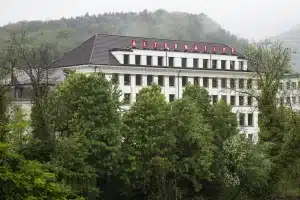
Where ABS doesn’t own its premises outright, it has still sought out sustainable options: its advisory services centre in Zurich operates from the Kalkbreite Cooperative building, one of only seven officially certified 2000-Watt sites in Switzerland at present.
Building Blocks for the future
These four institutions show that low-carbon buildings aren’t tied to one country or one type of financial institution. Each has taken its own route, geothermal systems, circular material passports, LEED certification, Minergie-P design standards, but they all point to the same idea: a bank’s own building can be one of the clearest ways to put its values into practice.