By Horla Natsagdorj, Communications Officer at the Global Alliance for Banking on Values
Finance shapes lives. It decides who gets a loan to start a business, whose community gets investment, and whose future gets funded. Yet for most of its history, the people making those decisions have looked remarkably similar, and women have rarely been among them.
That’s starting to change. Currently, around ten member institutions of the Global Alliance for Banking on Values (GABV) are led by female leaders. So this year, in honour of International Women’s Day, we spoke with three women on the GABV Board — leaders from values-based banks on three different continents, and in three very different contexts. We asked them the same questions. Their answers weren’t identical, but they pointed in the same direction: banking can be both purposeful and profitable, and women are helping make that case.
“Women are shaping the future of banking”
Mirela Pekmezi, FINCA DRC (Democratic Republic of Congo)
At FINCA DRC, Mirela has watched women transform the way the bank reaches its clients. By leading the expansion of mobile and agent banking, women on her team have built channels specifically designed for women entrepreneurs — safer to use, easier to navigate, and built around a genuine understanding of clients’ daily lives.
“Women are shaping the future of banking,” she says, “especially through a client-oriented approach focused on empathy, innovation, and communication.”
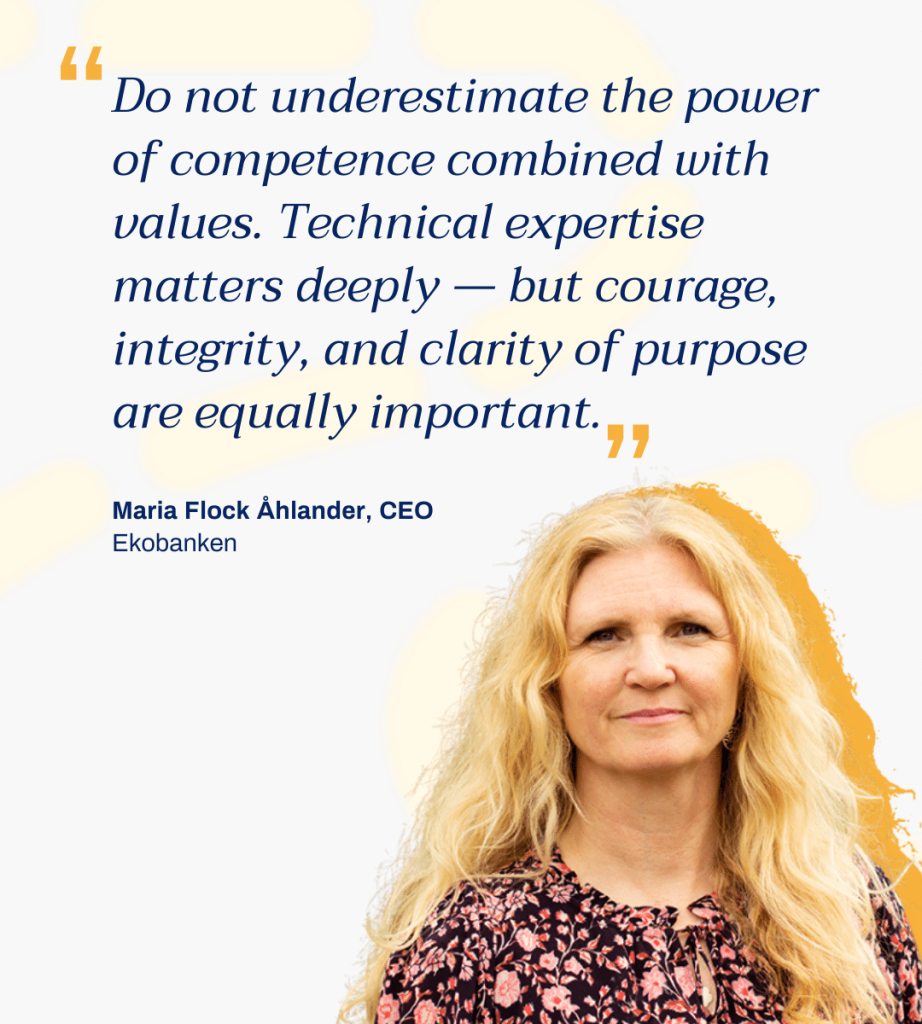 Maria Flock Åhlander, Ekobanken (Sweden)
At Ekobanken, a Swedish bank with a mission rooted in sustainability, Maria points to governance as the place where women’s influence runs deepest.
The bank maintains a 50/50 gender balance on its board and a 60/40 split in its management team — not as a symbolic gesture, but as a deliberate choice that shapes how decisions are made.
“Diversity is not symbolic,” she says. “It shapes how we make decisions.” In practice, that means credit assessments that weigh social and environmental impact alongside financial metrics, and a culture where transparency and long-term thinking aren’t buzzwords, they’re the operating model.
Margarita Cherikbaeva, Kompanion Bank (Kyrgyzstan)
In Kyrgyzstan, Kompanion Bank has made women’s leadership a structural fact, not an aspiration. Three of five board members are women, including the Chairperson. Women make up over 60% of the total workforce, and more than half of all leadership positions.
For Margarita, the numbers matter, but so does what they represent. “Representation is a step,” she says. “Influence is the goal.”
“Diversity is not symbolic. It shapes how we make decisions.” – Maria Flock Åhlander, CEO, Ekobanken
Leading through hard moments
When we asked about recent challenges, the answers were striking in their honesty.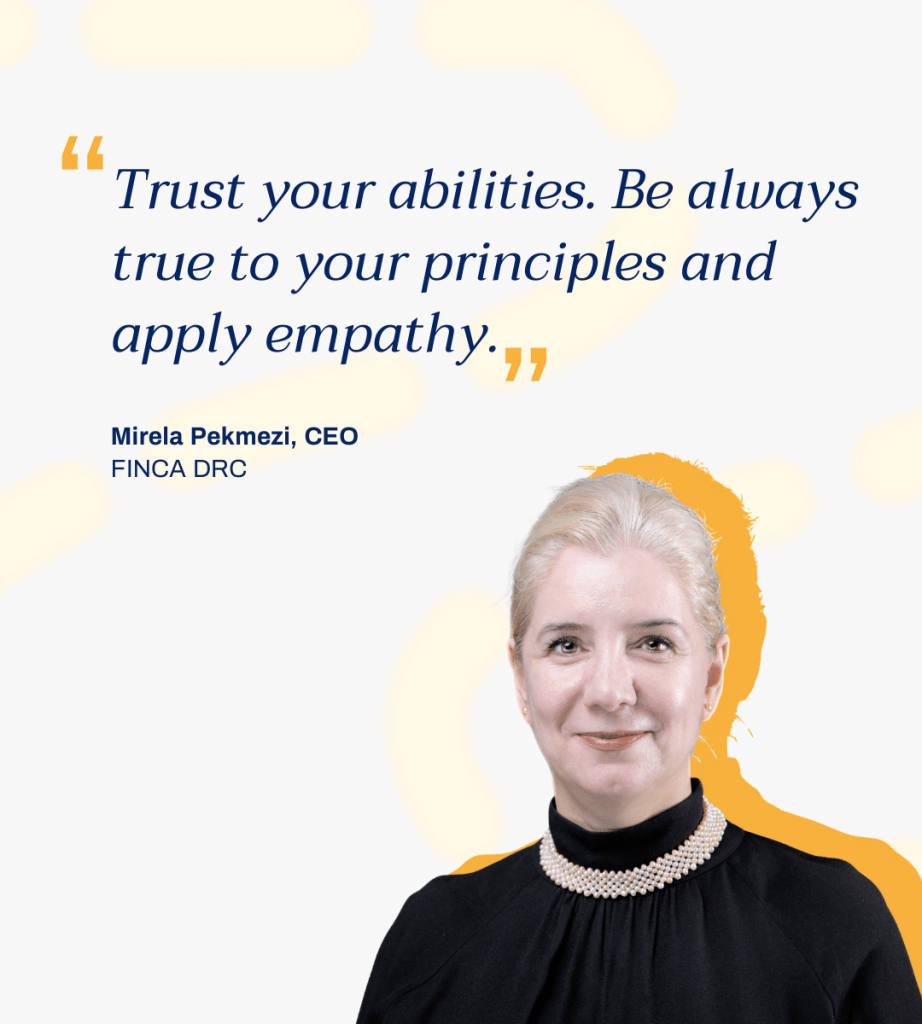
Mirela described something most banking executives never face: war. When conflict erupted in the DRC in early 2025, some FINCA staff were imprisoned. Her team faced an agonising choice — and chose not to pay bribes, even as colleagues remained behind bars for three months.
“We decided not to corrupt and to honour our values,” she says. “And our team in prison requested that.”
Maria spoke about a quieter but persistent tension: the pressure small, mission-driven banks face to grow faster, cut corners, or compromise on purpose in the name of survival. “There is a constant tension between scale and integrity,” she says. “Leading through that requires clarity, resilience, and the courage to make long-term decisions even when short-term pressures are strong.”
For Margarita, the challenge was the opposite problem: rapid success. Kompanion Bank has become one of Kyrgyzstan’s fastest-growing banks, and scaling quickly without losing what made the bank special required a specific kind of discipline. “Growth is always a test of maturity,” she reflects.
“Women are shaping the future of banking, especially through a client-oriented approach focused on empathy, innovation, and communication.” – Mirela Pekmezi, CEO, FINCA DRC
Does values-based banking make space for different leadership?
All three women gave an emphatic yes, and their institutions prove it.
When a bank’s purpose goes beyond profit, the qualities that define good leadership shift. Collaboration, listening, and long-term thinking stop being “soft skills” and start being core competencies. That creates room for leadership styles that more traditional institutions might overlook. “I had the pleasure to work for institutions that evaluated professionalism and meritocracy, so I can’t say that gender has influenced my work in banking,” says Mirela. ”But has enforced my conviction that women are capable and can perform once given equal opportunities.”
“Representation is a step. Influence is the goal.” – Margarita Cherikbaeva, CEO, Kompanion Bank
At Kompanion Bank, three of five board members are women, including the Chairperson, and women hold over half of all leadership positions, distributed across branches, product teams, and risk functions alike.
At Ekobanken, the 50/50 board shapes how decisions get made, from credit processes that weigh social impact alongside financial metrics, to a culture where transparency is an expectation, not an aspiration. At FINCA DRC, inclusion shows up in the products themselves — women-focused financial tools and leadership development that elevate the voices closest to the client.
“One does not have to be the toughest or the loudest to be effective,” says Margarita. “It is possible to be strategic, attentive to people, capable of listening and bringing others together — while still making firm decisions,” she continues.
Maria puts it plainly: when institutions measure themselves by impact and resilience alongside returns, different strengths get recognised — and different people get to lead.
Values-based banking doesn’t just tolerate inclusive leadership. It requires it.
What they’d tell the next generation
Each woman was asked for her single most important piece of advice for women entering finance. Their answers were different in tone but remarkably consistent in substance.
Mirela: “Trust your abilities. Be always true to your principles and apply empathy.”
Maria: “Do not underestimate the power of competence combined with values. Technical expertise matters deeply — but courage, integrity, and clarity of purpose are equally important.”
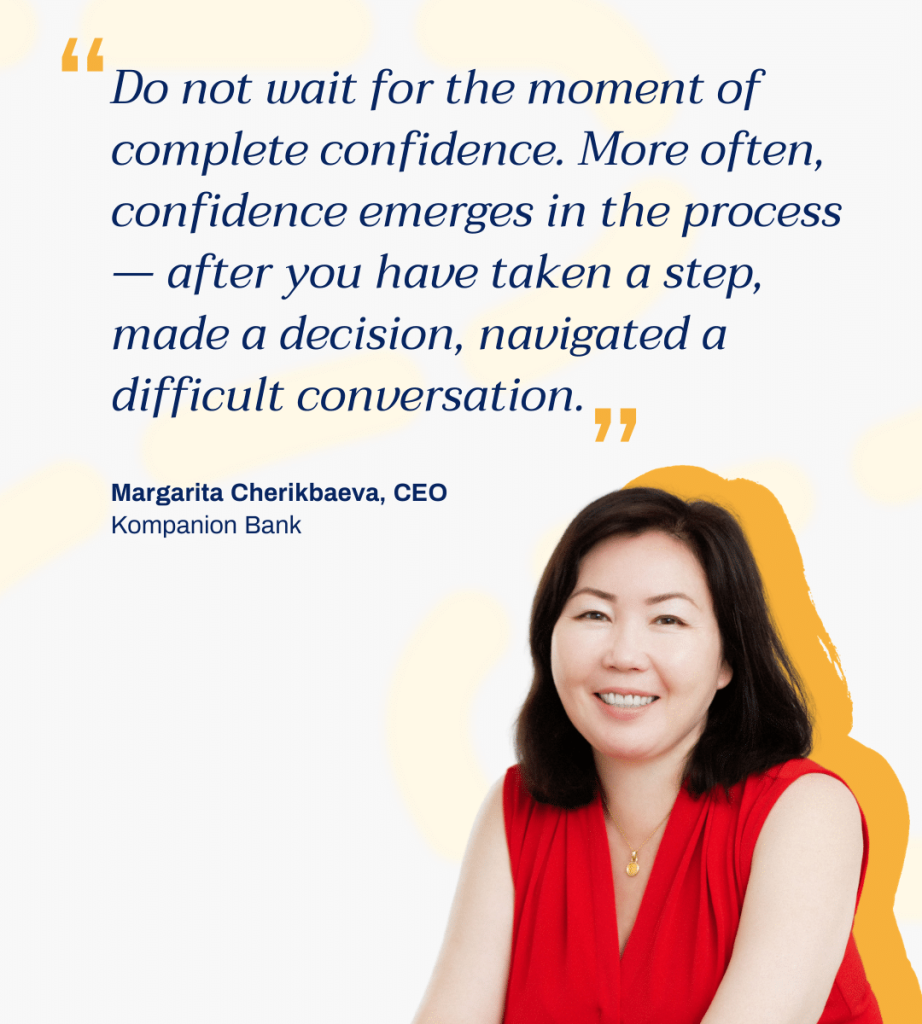
Margarita: “Do not wait for the moment of complete confidence. More often, confidence emerges in the process — after you have taken a step, made a decision, navigated a difficult conversation.”
The bigger picture
Women’s representation in financial governance has improved but unevenly, and mostly at institutions that were already committed to change. The Official Monetary and Financial Institutions Forum Gender Balance Index 2024 — which tracks women in leadership across 335 financial institutions, including central banks, sovereign funds, pension funds and commercial banks — found that only 16% of institutions were led by women, even though this is the highest share recorded in the index to date. In mainstream banking, the highest decision-making levels remain dominated by the same networks that have historically controlled them.
What these three leaders demonstrate is that there’s another way — and it works. But leadership representation is only part of the story. GABV member banks are also translating their values into concrete programmes that expand opportunity for women far beyond their own walls.
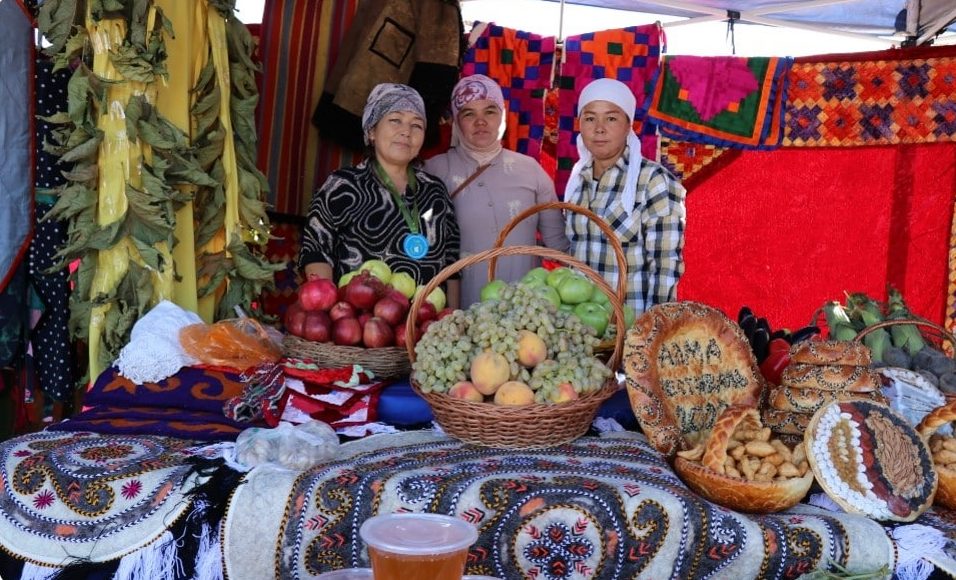
Kompanion Bank is a strong example. Across Kyrgyzstan, the bank runs free financial and agricultural literacy training, offers digital tools and advisory support tailored to rural women entrepreneurs, and holds regular internal gatherings where female employees discuss not just work, but health, balance, and career journeys.
In 2025, the bank joined the Women Entrepreneurs Finance Code (WeCode), a global initiative developed with the EBRD, and is implementing a Gender Action Plan through its partnership with the Asian Development Bank. “Supporting women is not about image,” says Margarita. “It is about the long-term resilience of the society of which we are a part.”
That philosophy, that women’s economic empowerment strengthens entire communities, not just individuals, runs through the broader GABV network.
As Maria puts it: “Sustainable transformation in finance will not come from louder voices. I hope it will come from wiser leadership.”