By Ugo Biggeri, Regional Representative for Europe, Global Alliance for Banking on Values (GABV)
Ugo Biggeri spoke at the CEE Sustainable Finance Summit in Prague, Czech Republic, where he presented a vision for the future of banking in the context of sustainability.
The banking industry stands at a crossroads. While sustainability has emerged as a defining theme for the financial sector’s future, the path forward remains frustratingly inconsistent and heavily influenced by shifting political winds. Recent setbacks, including as a result of a new Administration in the US and European rearmament priorities, underscore a fundamental challenge: the banking system’s approach to sustainability lacks coherence and commitment.
Yet despite these headwinds, one truth remains clear – sustainability will become increasingly fundamental to banking’s future viability. The question is not whether this transformation will occur, but how quickly and comprehensively the industry will embrace it.
Beyond Products: A Holistic Approach to Sustainable Banking
Conventional wisdom suggests that expanding sustainable finance products will be enough to drive this transformation. But real change requires a sustainability approach that permeates all financial activities – from credit evaluations and investment decisions to supplier relationships and operational practices.
Sustainable banking cannot be relegated to a specialised product line; it must become the foundation of institutional decision-making.
This comprehensive approach is not theoretical. Members of the Global Alliance for Banking on Values (GABV) banks are sustainable banking’s frontrunners. They have demonstrated that profitability and sustainability are not only compatible but mutually reinforcing. These institutions consistently outperform traditional banks on key metrics while maintaining rigorous environmental and social standards. Their success stems from a selection process that results in lower credit losses than the broader banking system, combined with strong reputational capital that attracts stable clients and provides access to equity financing at favourable rates.
The Limits of Market-Driven Change
 However, we cannot assume the banking system will voluntarily embrace this transformation, even as consumer demand for sustainable financial products continues to grow. Banks operate according to profit logic and follow market signals, giving them relatively limited influence over broader systemic change. While market forces will drive some progress, they alone cannot deliver the transformation required.
The current regulatory approach compounds this challenge. Rather than creating meaningful incentives for sustainable practices, much of today’s regulation focuses on sometimes excessive bureaucratic compliance around sustainable products. This approach misses the mark entirely. What the industry needs is regulation that disincentivises unsustainable finance and unsustainable businesses, creating clear market signals that reward genuinely sustainable practices while penalising harmful ones.
Learning from Sustainable Banking Leaders
GABV banks represent a treasure trove of practical experience in navigating the complex ethical dilemmas that define sustainable banking. They have developed sophisticated frameworks to balance social and environmental impacts, manage just transitions toward sustainability, and make difficult decisions when values and market pressures conflict. Their experience provides a roadmap for broader industry transformation.
These institutions demonstrate that sustainable banking can evolve beyond product development to be part of all aspects of an institution’s work.
The Path Forward
The future of banking will be sustainable, but this transformation requires more than market evolution. It demands regulatory frameworks that reward sustainable practices rather than creating compliance burdens, institutional commitment that goes beyond product innovation, and leadership that can navigate complex ethical terrain while maintaining financial performance.
Change will require new incentive structures, clear exclusion procedures for harmful financing, robust metrics for evaluating environmental and social impacts, attention to governance, and the institutional capacity to navigate ethical dilemmas with consistency and transparency.
The banking industry has the tools and knowledge needed for this transformation. GABV banks have proven that the model works. What remains is the collective will to implement these practices at scale and the regulatory environment to support genuine sustainability rather than mere compliance.
The future of sustainable banking is not a distant aspiration – it is an achievable reality waiting for the industry and policymakers to embrace the comprehensive change required. Regardless of political change and shifting domestic and regional priorities, wherever they happen in the world, the question is not whether this transformation will occur, but whether the banking industry will lead it or be forced to follow.
Expanding the Conversation: Ethical Finance and Prosperity
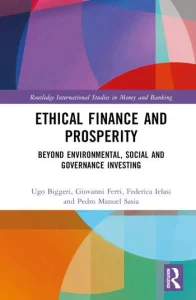 Ethical Finance and Prosperity: Beyond Environmental, Social, and Governance (ESG) Investing, co-authored by Ugo Biggeri invites readers to rethink the role of finance in society. The book challenges the limitations of current ESG frameworks and instead proposes a vision of finance grounded in ethics, sustainability, and shared wellbeing.
Drawing on academic research and practical examples, the authors make a compelling case for why a values-based approach to finance is not only possible but essential. It is a natural extension of the arguments laid out in Biggeri’s recent talk at the CEE Sustainable Finance Summit, and it aligns closely with the GABV’s mission to transform finance for a just, inclusive, and sustainable world.