By Andrea Baranes, President, Fondazione Finanza Etica (Banca Etica group)
“Hey, ChatGPT, which shares should I buy?”
It might sound like a question asked for fun, just to see what response you get. Yet, according to an article referencing a study conducted in 13 countries of 10,000 investors, one in ten turns to some form of artificial intelligence to inform their investment decisions. Many would consider handing over their actual investment decisions entirely to AI. From the research, it appears that chatbot responses are reasonable and cautious, emphasising that it is impossible to predict market movements given the complexity and number of influencing factors.
How finance works and why it’s different
The key point here refers to how financial markets operate. According to classical economic theory, the meeting of demand and supply determines the price, and the price in turn influences demand and supply. Here’s a simple example. I go to the market to buy some apples. If there are few apples (scarce supply) and many want them (high demand), the price will tend to rise. But as the price increases, fewer people will continue to demand the apples. They will buy other products or go to other markets. The drop in demand then leads to lower prices and a new equilibrium.
This is how markets for most goods work — except for one: the financial market, the biggest in the world and with the greatest impact on our lives. In this case, the more in demand an asset (share, bond or other) is, the higher its price rises. But the rise does not discourage demand — quite the opposite. Contrary to the law of supply and demand, when the price of an asset goes up, everyone wants to buy it, and the rising price attracts more demand and more investors.
Until some (even relatively minor) event triggers selling. At that point, the trend reverses and a downward spiral begins. This is how bubbles burst. And in that sense, finance is intrinsically unstable and characterised by irrational behaviour, with phases of euphoria and panic.

This dynamic is exacerbated by the fact that investment decisions are increasingly based on whether a given asset is rising or falling, not on how the corresponding company is performing. Investment choices should be based on so-called fundamentals: is the company’s product of good quality, does it have a valid business strategy, is it financially sound, does it invest in research and development, etc.
In a financial system driven by speculative and very short-term logic, decisions are increasigly not based on such analysis (known as fundamental analysis). More and more investors look solely at recent asset price movements, regardless of the company’s products or services. In other words, investment decisions are based on the examination of charts, prices and trading volumes — so-called technical analysis.
Herd effect and AI: when algorithms move markets
Into this mode of investment — where short-termism and technical analysis dominate — steps AI. The development of AI applied to financial markets has seen a remarkable growth in just a few years. Not only — as noted in the introduction — for retail investors asking ChatGPT, but increasingly for large funds and institutional investors.
In simple terms, AI algorithms analyse — statistically — a huge amount of data on past market behaviour, indices, and individual assets to try to anticipate signals that might cause a given share or other asset to rise or fall. They seek to “learn” how and why in the past certain assets did or didn’t perform well— in order to predict future market performance, irrespective of what the company produces or even what its name is. This is the triumph of technical analysis over the enterprise’s economic fundamentals.
But there are some significant problems. First: the number of companies able to develop software for market learning is very small. Second: these algorithms all feed off the same historical series and the same data. The result is that their predictions and indications risk being extremely homogeneous. Or put another way, the systems may all indicate buying a given asset and selling another at the same time. Which could lead to a dramatic herd effect — that is, markets moving in unison in response to AI directives.

And these are not the warnings of doomsayers hostile to technology. The European Central Bank (ECB) itself, said in a May 2024 study that:
“Artificial intelligence may distort the market’s information-processing function, increasing the potential for endogenous crises in financial markets … The interpretation of information may become more uniform if increasingly similar models with the same built-in challenges and biases were widely used to understand the dynamics of financial markets. Consequently, artificial intelligence can lead to systematically distorted market participants’ conclusions, asset-price distortion, increased correlation, herd behaviour or bubbles.”
Algorithms studying algorithms: the spiral of automated finance
The risk of bubbles and crises does not stem “only” from this herd behaviour, but also from the fact that all market participants — even those not using AI to decide what to buy or sell —know of this dynamic. If nearly everyone is buying a given asset based on technical analysis, then that analysis itself drives the supply and demand of that asset, thereby determining its market price. Paradoxically, an investor who chose to base his decisions on fundamental analysis — that is, for example, whether a company’s accounts are in order, whether it actually produces something useful and high quality — might thus perform worse.
At least in the short term. Over the long term, the prices should tend to reward the better companies and penalise the others. The problem is that the short-term perspective overwhelmingly dominates the financial system.
An oligopoly squared: a few players dominate AI and finance
If these processes undermine financial stability and risk amplifying the herd effect, AI can also threaten the financial system in other ways. As we’ve learned, the number of technology firms that develop algorithms is very small — especially those with the ‘expertise’ in finance. To this technological concentration is added that of financial markets, dominated by a few large institutional investors.
In summary, a tech oligopoly supplies the algorithms that drive investments in markets; these markets are themselves dominated by a financial oligopoly of institutional investors who are the major shareholders in those very tech firms. What could possibly go wrong?
The ECB warns that: ”Widespread adoption of artificial intelligence could increase market concentration in the financial services sector. The integration of AI into corporate structures may require large initial fixed investments and represent economic risks.”
Is it really an irrational market?
With the spread of AI in investment decisions among smaller investors, too, the risk of a herd effect may reach peaks never before seen in the already turbulent history of financial markets. Instability and crises are not bad for everyone. On the contrary: speculation thrives on volatility and instability. By definition, to speculate means to buy something at a given price and to resell it as quickly as possible at the highest possible price (today, one can also bet on the collapse of an asset). The more extreme and rapid the price fluctuations, the more one can gain from speculative activity.
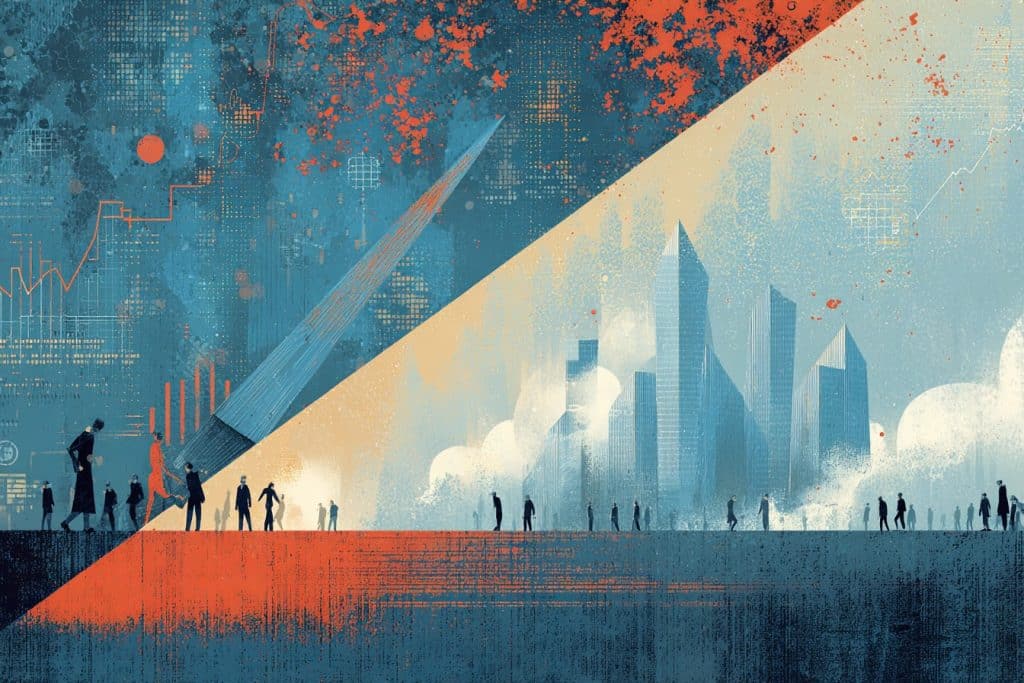
The point then becomes how to ride these excesses and this irrationality — in other words, how to buy and sell before everyone else. Which translates into having the best information and the best calculation algorithms to outpace the competition. Or, put differently, being in a position of strength both technologically and financially. Once the herd is large — meaning more people and more capital involved — the bigger the haul. Only the very few have these advantages.
In this sense, we shouldn’t speak of an “irrational intelligence”. On the contrary, the “oligopoly-squared” that now dominates AI and financial markets is behaving perfectly rationally. The reality is that the mountains of capital flowing into this sector are — and may increasingly be — flowing to the advantage of a very small number of technological and financial players.
In conclusion, the main risk is the growing separation between a small number of dominant players who capture nearly all the benefits, and the rest of the productive system and society, who risk paying the price. The much-lauded “revolution” promised by artificial intelligence may end up being nothing more than the widening of an already unacceptable gap in a financial system that already magnifies inequalities and drains resources from broader society and the productive system into a small minority.
This translation has been prepared for publication on GABV.org with the author’s consent, and the original Italian version remains available at: Valori.it – “L’intelligenza irrazionale. Come l’IA alimenta le bolle finanziarie”. Images created by Valori.it with Midjourney.