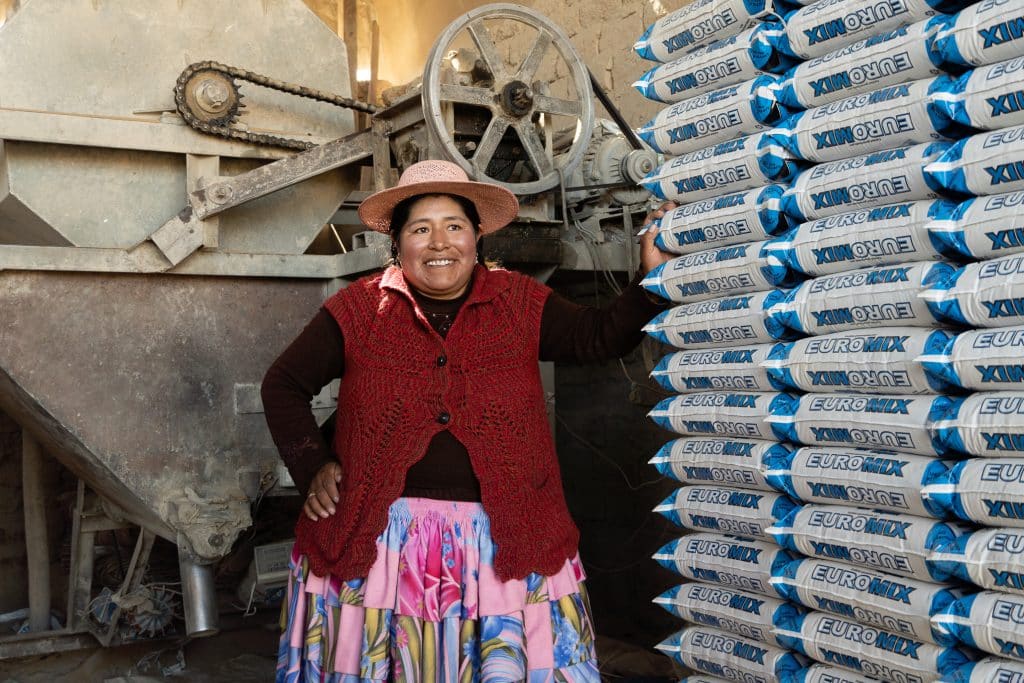
‘Our mission is to provide opportunities for a better future to low-income sectors in Bolivia through access to financial services of the highest quality. That is why we have decided not to move upwards in the market.’
Kurt Koenigsfest, CEO
Kurt Koenigsfest, the CEO of Banco Solidario S.A. (BancoSol), reviewed a slide deck ahead of an upcoming presentation to the bank’s Board of Directors. BancoSol was a microfinance bank headquartered in La Paz, Bolivia, with an outstanding loan portfolio of about $1.17 billiona as of the end of 2015. BancoSol’s mission was to provide financial services and opportunity to individuals and companies in low-income sectors throughout Bolivia. In its first 16 years, BancoSol had disbursed more than $5.8 billion to more than 2,400,000 micro-enterprise projects. The bank was present in eight major cities (La Paz, Cochabamba, Santa Cruz, Oruro, Sucre, Tarija, Potosí y Trinidad) through a network of more than 100 branches.1 But a regulatory change had prompted a review of its strategy.
 Passed in 2013, Bolivia’s Nueva Ley Bancaria (NLB), or new banking law, required that by 2018 all banks extend 60% of their loans, by volume, to the productive sectorb at no more than 11.5% interest rates. (BancoSol’s average rates for such loans hovered around 18% as of 2015.) Banks had to meet a series of intermediate volume targets during each interim year. At the end of 2015, BancoSol had almost 39% of its loans in the productive sector. Roughly another 7% of its loan portfolio needed to shift each subsequent year to the productive sector, and away from sectors such as trade or services, to reach the 60% target on time. Meanwhile, BancoSol’s rates on productive sector loans were forced to fall to 11.5% at the end of 2015. While remaining loyal to its mission, the bank had to find ways to recoup that lost interest income and continue to grow. From 2009 through March 2015, ROEc had averaged 28.9%, but as the law’s provisions became effective, ROE would come under pressure. Koenigsfest thought that ROE should not fall below a floor of 15%, even if maximizing ROE was not his priority.
Highlights
- Bolivia has developed what was perhaps Latin America’s most successful microfinance industry. During the 1980s, 1990s, and 2000s, hundreds of thousands of poor people in Bolivia had gained access to credit and built businesses with the help of a microfinance industry that advanced quickly, particularly in urban areas, and flourished amid competition.12 By 2015, BancoSol was the largest player in the Bolivian microfinance industry.
- ‘Our mission is to provide opportunities for a better future to low-income sectors in Bolivia through access to financial services of the highest quality. That is why we have decided not to move upwards in the market.’ Kurt Koenigsfest, CEO BancoSol.
- Passed in 2013, Bolivia’s Nueva Ley Bancaria (NLB), or new banking law, required that by 2018 all banks extend 60% of their loans, by volume, to the productive sector at no more than 11.5% interest rates. How would Koenigsfest achieve what seemed like a series of contrary goals—serving BancoSol’s mission as a microfinance bank, maintaining return on equity, avoiding layoffs, and complying with productive sector loan targets under the NLB?
Download the case study, courtesy of Harvard Business School.