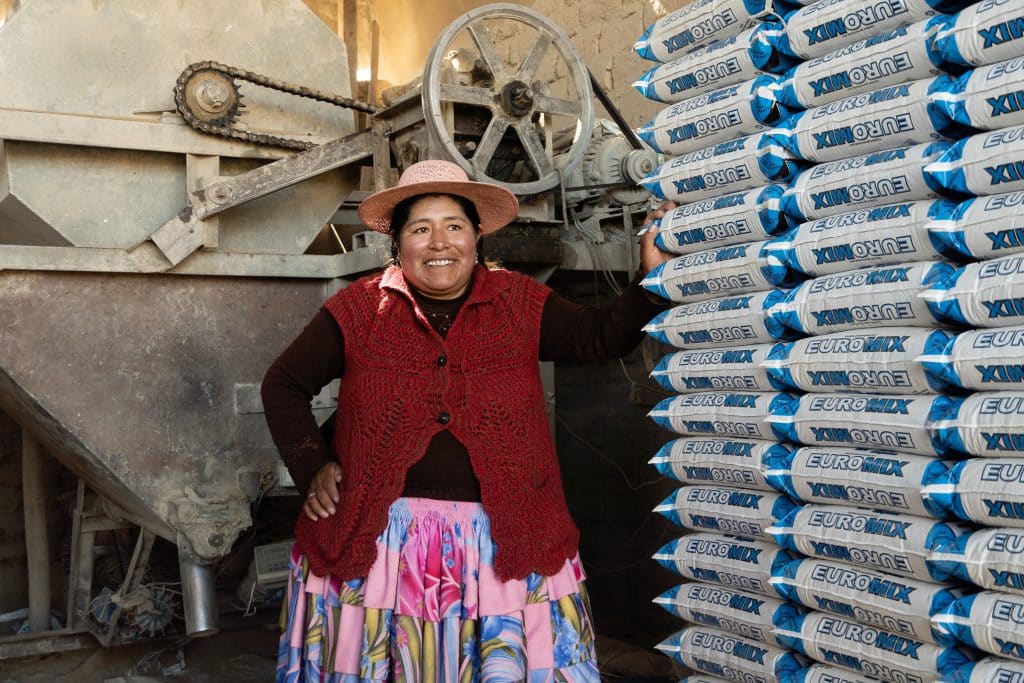
Tajikistan is a country where small businesses power nearly everything. Micro and small enterprises contribute around 60 percent of the country’s GDP, forming the backbone of local economies in villages, marketplaces, and hillside communities across one of Central Asia’s most mountainous nations. And yet, for many of the people running those businesses — a woman selling goods at a rural market, a family trying to build a home, a farmer investing in better equipment — the formal financial system has long felt like something built for someone else.
The numbers tell the story plainly. According to the International Finance Corporation (IFC), micro and small enterprises in Tajikistan face a financing gap estimated at around 20 percent of GDP — nearly USD 3 billion. That gap reflects the scale of unmet demand among the country’s smallest businesses, many of which represent the main source of income for people who lack access to affordable financial products and services. That is not just a statistic. It is the sum of businesses that could not start, homes that could not be built, and opportunities that quietly disappeared because affordable credit was out of reach.
Bank Arvand has spent years working against that reality. A member of the Global Alliance for Banking on Values (GABV) rooted in the principles of inclusive, values-based finance, the bank serves more than 58,000 borrowers across Tajikistan. They focus on the communities and individuals that mainstream banking rarely prioritises: rural entrepreneurs, women-owned businesses, low-income households, and micro enterprises operating at the edges of the formal economy. And now, with a new USD 5 million partnership with IFC, Bank Arvand is going further.
Reaching small businesses, women entrepreneurs, and rural borrowers
With this financing, provided by IFC in local currency and structured for the long term, Bank Arvand aims to reach specific groups facing specific barriers, in a country where those barriers have real and lasting consequences.
A significant portion will go toward expanding lending to micro and small enterprises, including those owned by women. In Tajikistan, women entrepreneurs often face a double barrier: limited access to credit and limited access to the networks and information that would help them navigate financial systems. Bank Arvand’s approach is to meet those borrowers where they are, with products designed around their realities rather than around the preferences of the financial system.
Rural entrepreneurship is another central focus. Outside Dushanbe and the country’s major urban centers, access to affordable finance becomes dramatically harder to find. Transport costs, distance from branch networks, and a lack of credit history all compound to exclude rural borrowers from the opportunities available to their urban counterparts.
By expanding its reach into those communities, Bank Arvand is living out what values-based banking stands for: treating geography as a challenge to solve, not a reason to walk away.
“Micro businesses and women entrepreneurs are a key part of Tajikistan’s economy,” said Shoira Sodiqova, CEO of Bank Arvand.
“This financing from IFC will make it possible for more of them to access credit, and help them to expand and create jobs. In addition, we aim to help address the current lack of access to affordable housing finance.” (Shoira Sodiqova, CEO, Bank Arvand)
A roof over your head
Housing might seem like a separate issue from small business finance. In Tajikistan, it is not. For low-income families, particularly in rural areas, the inability to build or renovate a home is not just a quality of life issue, it is an economic one. An inadequate home affects health, productivity, children’s education, and a family’s ability to withstand shocks.
Bank Arvand will use a portion of the IFC financing to expand its micro-housing loan programme, specifically targeting low-income families in rural communities. These are small loans, measured in hundreds rather than thousands of dollars, but they carry the weight of something larger: the possibility of a stable foundation from which a family can build.
The energy dimension
Woven through the partnership is a third strand that speaks to a longer-term challenge: energy efficiency. Tajikistan’s households and small businesses bear a significant burden from inefficient energy use — both in cost and in environmental impact. Bank Arvand will support initiatives that help borrowers adopt more efficient energy practices, reducing costs over time while contributing to more sustainable local economies.
It is a small but meaningful signal that inclusive finance and environmental responsibility are not competing priorities. When managed well, they reinforce each other.
Read more about Bank Arvand’s work at arvand.tj and the IFC partnership here.