When refugees arrive in Uganda, they often carry little more than memories of home and the hope of starting anew. For many, rebuilding a life means finding a way to participate in the economy – growing food, starting businesses, and supporting their families. Yet without access to financial services, these aspirations can remain out of reach.
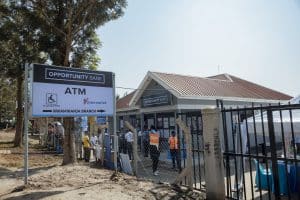
Opportunity Bank Uganda Limited (OBUL), a member of the Global Alliance for Banking on Values (GABV), has long understood that financial inclusion is key to resilience. On 14 August 2025, the bank opened its 25th branch in the heart of Rwamwanja Refugee Settlement in Western Uganda, extending its pioneering approach to refugee financing to more than 110,000 refugees and their host community neighbours.
This settlement was originally established in 1964 for Rwandan refugees but was reopened in 2012 to accommodate the large influx of Congolese refugees fleeing conflict in the Democratic Republic of Congo (DRC). While it was once at full capacity, recent population figures show it hosts over 100,000 refugees, predominantly from the DRC, alongside smaller numbers from Rwanda, South Sudan, and Burundi. The settlement receives support from organisations like UNHCR, the Ugandan Office of the Prime Minister and development NGOs like Opportunity International, which provide services ranging from food and water to education, healthcare and digital learning opportunities.
From humanitarian response to sustainable development
OBUL was the first commercial bank in Uganda to open a branch inside a refugee settlement when it launched operations in Nakivale in 2019. That experience showed that refugees, given access to the right tools, can thrive as entrepreneurs, farmers and community leaders. Today, OBUL serves over 19,000 refugee clients nationwide and has disbursed more than USD 1 million (UGX 4 billion) in refugee-focused loans.
The new Rwamwanja branch builds on this legacy, reaffirming OBUL’s role as a purpose-driven institution that bridges humanitarian response with long-term economic empowerment. “The opening of our Rwamwanja branch is more than a business milestone; it’s a reaffirmation of our vision and commitment to walk alongside this community as they rebuild their lives with dignity and purpose,” said Owen Amanya, CEO of Opportunity Bank Uganda.
Rooted in community needs
Agriculture is the backbone of Rwamwanja’s economy, and the branch is designed to serve it. Refugees and host community members will now have access to specialised loans for agricultural inputs and small agribusiness ventures. Women-led groups and youth enterprises will also receive targeted support, alongside financial literacy training that helps households make informed, sustainable financial decisions.
For Mary Oakes, CEO of Opportunity International UK, OBUL’s partner in this initiative, the project reflects the power of value-based banking: “Our partnership continues to demonstrate how community-rooted financial solutions can drive long-term change. Together, we are enabling both refugees and host communities to build secure, dignified, and prosperous futures.”
Where dignity meets determination
The new branch is more than a building. It is a symbol of opportunity where resilience meets resources. “Rwamwanja represents more than a branch – it is a place where dignity meets determination, and where resilience is met with opportunity,” said Jacqueline Kobusingye Opondo, Chairperson of OBUL’s Board of Directors.
With support from the Office of the Prime Minister, UNHCR, and other stakeholders, OBUL’s work in Rwamwanja illustrates what values-based banking looks like in action: meeting people where they are, recognising their potential and equipping them with tools to shape their own futures.
A model for inclusive banking
As part of the GABV, Opportunity Bank Uganda is helping redefine what banking can achieve. By integrating financial inclusion into the fabric of the refugee response, OBUL is demonstrating that refugees are not just recipients of aid, but also active contributors to Uganda’s economy.
For the families of Rwamwanja, this new branch is not just about access to credit or savings; it is about the chance to build livelihoods, invest in education and create futures filled with dignity and hope.