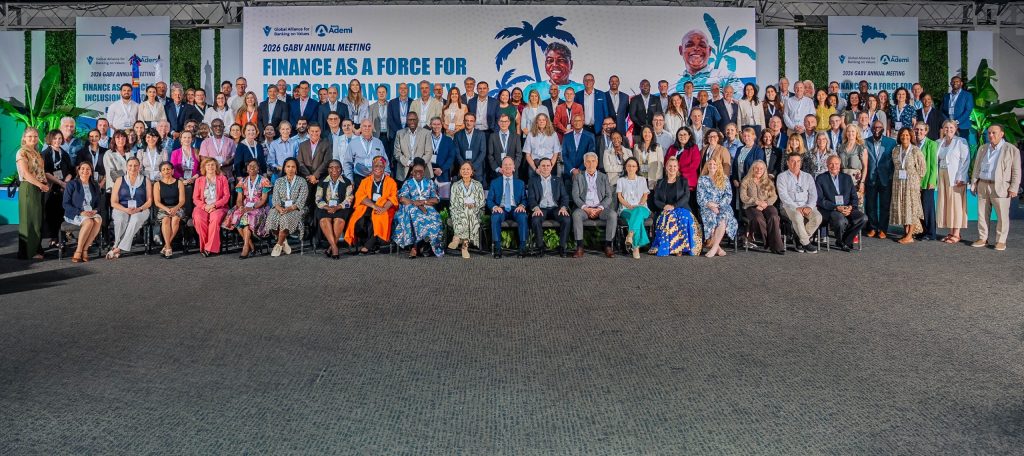
For more than a decade, the Presencing Institute has worked in supporting values-based banking, including helping establish the Global Alliance for Banking on Values (GABV) network and jointly running its Leadership Academy. Recently, I spoke with Ziauddin Haidari, CEO of First MicroFinanceBank Afghanistan (FMFB-A), about how the bank navigated the political and economic transition following the regime change in Afghanistan and how the GABV network supported its move toward Islamic banking — a Sharia-compliant approach to finance based on real economic activity, fairness, and shared risk.
Through small-scale financing and financial services, First MicroFinanceBank Afghanistan (FMFB-A) supports farmers and entrepreneurs across Afghanistan’s rural regions.
In August 2021, Afghanistan entered a period of profound political and economic upheaval. As the government collapsed and institutions across the country struggled to function, the financial sector faced an immediate and unprecedented shock. For banks operating in the country, the situation quickly became chaotic. “There was fear of a lack of law and order,” recalls Mr. Ziauddin Haidari, CEO of The First MicroFinanceBank Afghanistan. “Many bank officials left the country. It was really a chaos situation.”
In such an environment, many financial institutions struggled to operate. Liquidity pressures increased, uncertainty spread across the banking system, and public trust became fragile. Yet in the midst of this turmoil, FMFB-A managed to remain operational and maintain stability.
“I remember those days during the regime change,” Haidari says. “Liquidity was a big challenge, but in our case you could not see any single person standing outside any of our branches.”
This ability to continue operating during a systemic shock was not accidental. According to Mr. Haidari, it was the result of years of proactive scenario planning and stress testing, internal restructuring, and a strong institutional mission rooted in financial inclusion and community relationships.
“Resilience of institutions comes from the resilience of individuals who work in those institutions,” Haidari explains. “And our bank has always had a strong social mission and close relationships with communities at the grassroots level.”
This mission-driven approach — combined with careful preparation and strong internal systems — would prove critical in helping the bank navigate one of the most difficult periods in Afghanistan’s recent history.
Origins: A Bank Built for Afghanistan’s Real Economy
The First MicroFinanceBank Afghanistan (FMFB-A) was established in 2004 with a clear social mission to improve quality of life by expanding access to financial services in a country where large parts of the population had little or no access to formal banking.
“The bank was set up with a social mission and a development objective in Afghanistan,” explains Mr. Haidari. “The goal was to contribute to the economy of this country, which had been destroyed due to civil wars.”
The bank was created with the support of several international development institutions, including the Aga Khan Development Network, the International Finance Corporation (IFC) of the World Bank Group, and Germany’s development bank KfW.
Over the past two decades, the bank has grown into one of Afghanistan’s leading financial institutions. According to Mr. Haidari, it has supported more than 740,000 small and medium-sized businesses, channeling over $1.2 billion in financing into the country’s real economy.
“The impact has reached millions of people,” he says. “Directly, perhaps four to five million people in Afghanistan.”
From the beginning, the bank focused on building strong relationships at the grassroot level. By working closely with small entrepreneurs, farmers, and local businesses, it developed a strong presence in regions where access to finance was often extremely limited.
In 2016, the bank also joined the Global Alliance for Banking on Values (GABV), becoming part of an international network of financial institutions committed to using banking as a force for sustainable and inclusive economic development.
Impact on the Ground: Building Trust in Communities
For Mr. Haidari, the true impact of the bank’s work is best understood through the stories of the people it serves.
“One story that stayed with me personally,” he recalls, “was when I visited one of our branches in a very remote part of Afghanistan”. During the visit, colleagues introduced him to a local carpenter who had received a small loan from the bank. The man shared a difficult story, he had struggled to rebuild his life.“
A carpenter supported by First MicroFinanceBank Afghanistan in his workshop in rural Afghanistan. The small business now provides income for several families.
But with the help of a small loan, he was able to purchase equipment and open his own carpentry workshop.
“He told me that he now had his own shop and was employing four other people,” Haidari says. “Those four people were supporting four families.”
For Mr. Haidari, moments like this reveal the deeper purpose of the institution. “That was something I was really proud of,” he says. “The bank has changed many lives in different parts of the country.”
Over the years, similar stories have emerged across Afghanistan — from farmers expanding their production to small entrepreneurs starting businesses in local markets.
Even in the years following the political transition, the bank has continued supporting communities. According to Mr. Haidari, during the last four years alone the bank has provided around $84 million in financing, helping 38,000 small and medium-sized businesses re-establish their livelihoods.
Many of these efforts have focused on supporting returnees and internally displaced people, often in partnership with international organizations.
These relationships at the community level have helped build something that is particularly valuable in times of uncertainty: trust. That trust would later prove crucial when Afghanistan’s financial system faced one of its greatest shocks.
Read the full article here.
Originally published on 24 March 2026.