

A group of banks from the Global Alliance for Banking on Values (GABV) have endorsed the Fossil Fuel Non-Proliferation Treaty initiative. They are frontrunners in joining the call for the Treaty and call on the financial industry to follow their example. Values-based banks are taking a significant step forward in a global effort to address the root cause of the climate crisis – the production and use of oil, gas and coal.
Banks to endorse the Fossil Fuel Treaty initiative are:
- Amalgamated Bank (USA)
- Alternative Bank Schweiz (Switzerland)
- Banca Etica (Italy, Spain)
- BancoSol (Bolivia)
- Banco Popular (Honduras)
- Bank of Karditsa (Greece)
- Beneficial State Bank (USA)
- Centenary Bank (Uganda)
- Charity Bank (UK)
- Clearwater Credit Union (USA)
- Climate First Bank (USA)
- Cultura Bank (Norway)
- Ekobanken (Sweden)
- Freie Gemeinschaftsbank (Switzerland)
- Finca DRC (Democratic Republic of Congo)
- Merkur Cooperative Bank (Denmark)
- NMB Bank (Nepal)
- Summit Credit Union (USA)
- Sunrise Banks (USA)
- 3Bank (Serbia)
- Triodos Bank (Netherlands, Belgium, UK, Spain, Germany)
- UmweltBank (Germany)
- Unity Trust Bank (UK)
- Vancity (Canada)
- vdk bank (Belgium)
What is the FFNPT Initiative
The Fossil Fuel Non-Proliferation Treaty (FFNPT) Initiative is a global effort to foster international cooperation to accelerate a transition to renewable energy for everyone, end the expansion of coal, oil and gas, and ultimately equitably phase out existing production in keeping with what science shows is needed to address the climate crisis.
The FFNPT aims to meet the goals of the Paris Agreement (2015) to limit the global temperature rise to 1.5ºC by explicitly tackling the largest driver of the climate crisis: fossil fuels. At this stage, this is a proposal. The Treaty is not in existence yet. The proposal for a global mechanism to manage fossil fuel production has gained momentum in various diplomatic and academic circles, including the past COP28 in Dubai.
The engagement of the private sector is crucial. As the climate crisis intensifies, businesses are coming under increasing regulation and scrutiny to demonstrate how they are preparing adequately for the inevitable climate transition. The financial sector in general, and banks in particular, holds a privileged position primarily due to its central role in allocating capital and managing financial resources within the economy.
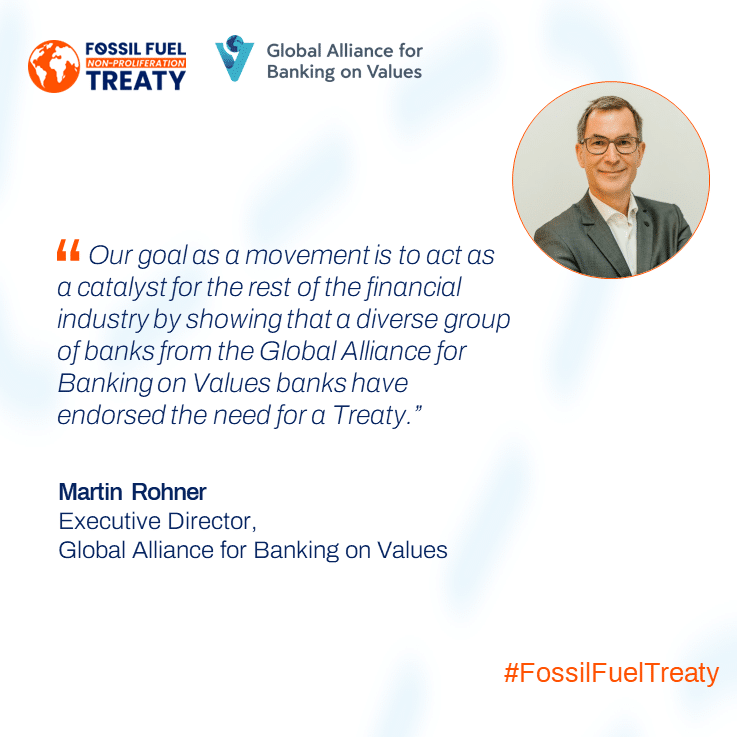
The GABV wants to endorse the Treaty proposal so others in the mainstream, and values-based, financial industry follow suit. By doing so, mounting pressure should nudge governments to do the right thing so the Treaty becomes reality and material action is taking ultimately to phase out fossil fuels and keep temperature increases within safe levels.
A secondary benefit is to prompt collective action, encourage sharing of best practice and expand a commitment to reduce fossil fuels finance among GABV members.
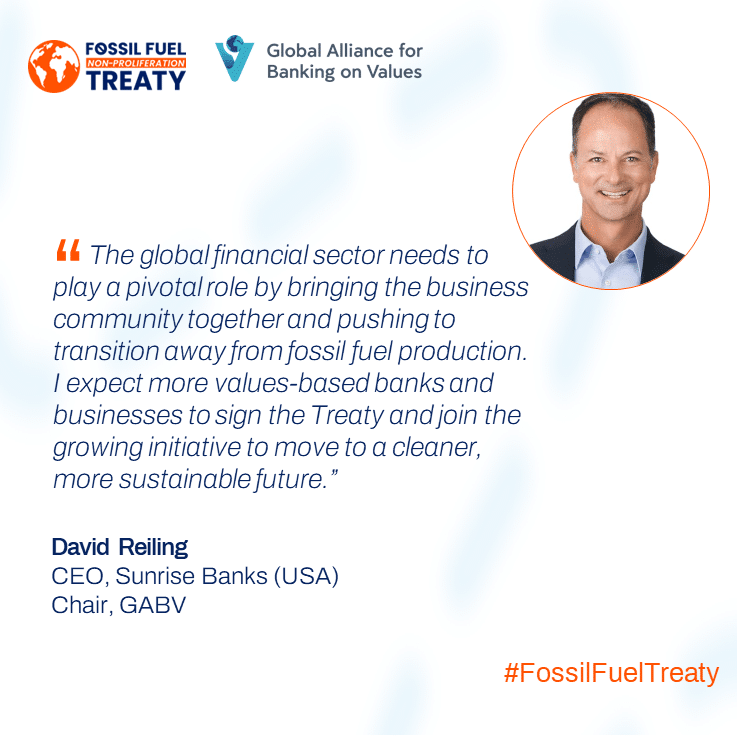
ENDORSING QUOTES FROM GABV BANKS
Learn what GABV leaders have to say
The Context
The world is on a dangerous course, set to exceed levels of warming that the global scientific community has called catastrophic. And we know the consequences of that climate disruption are not felt equally, with many of the less affluent and less polluting countries and communities most at risk.
The Paris Climate Agreement adopted in 2015 sets specific targets to be collectively achieved to limit global warming to well below 2°C, and preferably to 1.5°C, offsetting the equivalent carbon emissions produced by the same amount elsewhere.
2023 was the warmest year in the 174-year observational record. Global carbon dioxide emissions rose to record highs in 2021–2022. Emissions should be decreasing by now and will need to be cut by almost half by 2030, if warming is to be limited to 1.5°C.
Fossil fuels are the largest driver of climate change, responsible for 86% of carbon dioxide emissions in the past decade (IPPC). According to the International Energy Agency, the expansion of fossil fuels is unnecessary and incompatible with a 1.5°C target.
Projected CO2 emissions from existing fossil fuel infrastructure without additional abatement would exceed the remaining carbon budget for 1.5°C (50%), says the IPPC. Not enough with this, a report finds that governments plan to produce around 110% more fossil fuels in 2030 than would be consistent with limiting warming to 1.5°C, and 69% more than would be consistent with 2°C. As this report states: “There is a need for governments to adopt both near- and long-term reduction targets for fossil fuel production […]”
Why a Treaty
The Paris Agreement does not reference fossil fuels as the main contributor to climate change. This omission has received growing attention by leading research institutions and experts, supranational organisations such as the UN Environment Programme (UNEP) or the World Health Organisation, and civil society.
At the last COP in Dubai, the world, together, agreed to this shift away from fossil fuels. But there is no plan or framework to manage that transition. That is what the Treaty is intended to accomplish.
There are precedents in other international mechanisms that have managed threats of nuclear weapons and landmines. Nations came together between 1965-68 and agreed to stop the new production of arms, reduce existing stockpiles, and promote peaceful technologies via the Nuclear Non-Proliferation Treaty (NPT).
Understanding climate change as another existential global threat, a global campaign and diplomatic initiative calling for governments to negotiate a Fossil Fuel Treaty was launched in September 2020. Since then, it has gained further support from a diverse range of institutions, Nobel laureates, thought leaders, cities and governments of some small states particularly threatened by the effects of climate change9.
The Treaty does not yet exist. By signing up, GABV banks are endorsing a proposal for a Treaty to create a plan that complements the Paris Climate Agreement.
JOIN THE CALL FOR A FOSSIL FUEL TREATY
Businesses for a Fossil Fuel Treaty
The role of the Financial Sector
The Paris Climate Agreement recognised the financial sector as an enabler of the most ambitious climate-related goals. Since then, every COP has explicitly referenced the financial system’s role in supporting the just transition.
During the COP26 summit in Glasgow in 2021, major western banks pledge to reduce their carbon footprint10 and invest in green initiatives, aiming to achieve net zero emissions by 2050. However, recent data indicates a lack of progress. According to the 2024 Banking on Climate Chaos report, the world’s 60 biggest banks committed $6,9 trillion over 8 years to the fossil fuel industry, driving climate chaos and causing deadly local community impacts. A recent report by Topo Finance found that if the largest banks and asset managers in the U.S. were a country, they would be the third-largest emitting country in the world, behind China and the U.S.
Despite commitments, the ratio of bank financing for low-carbon energy projects to fossil fuels falls short of targets, as research from Bloomberg NEF revealed.
This gap between promises and actions underscores the pressing need for stronger measures to address climate change within the banking sector. If the financial sector is serious about its sustainable commitments, it should support the treaty initiative. A treaty will help create a steady business climate with long term perspective and a level playing field, which is in the interest of every business and financial institution.
The role of the GABV
Until April 2024, Triodos Bank was the only bank in the world to sign the proposal for a Treaty.
To add more banks to that list, the GABV signed a Memorandum of Understanding with the Fossil Fuel Treaty Initiative in March 2024. This MoU means GABV members automatically qualify to endorse the Treaty, due to their values-based banking approach.
The implications of endorsing the Treaty are very limited for GABV banks. Signing does not mean a member bank has to make any changes to its portfolio. Nor does it imply any additional reporting requirements. Banks are simply agreeing to be listed as endorsers of the Treaty, together with their colleagues in the GABV. As such they also have the opportunity to participate in publicity during the year that will materially benefit this important initiative and position them as playing a catalytic role in using finance to address the climate crisis.
Do you want to know how to endorse the Treaty? Contact us


